
How Does the CBSE Curriculum Help Students Prepare for Competitive Exams?
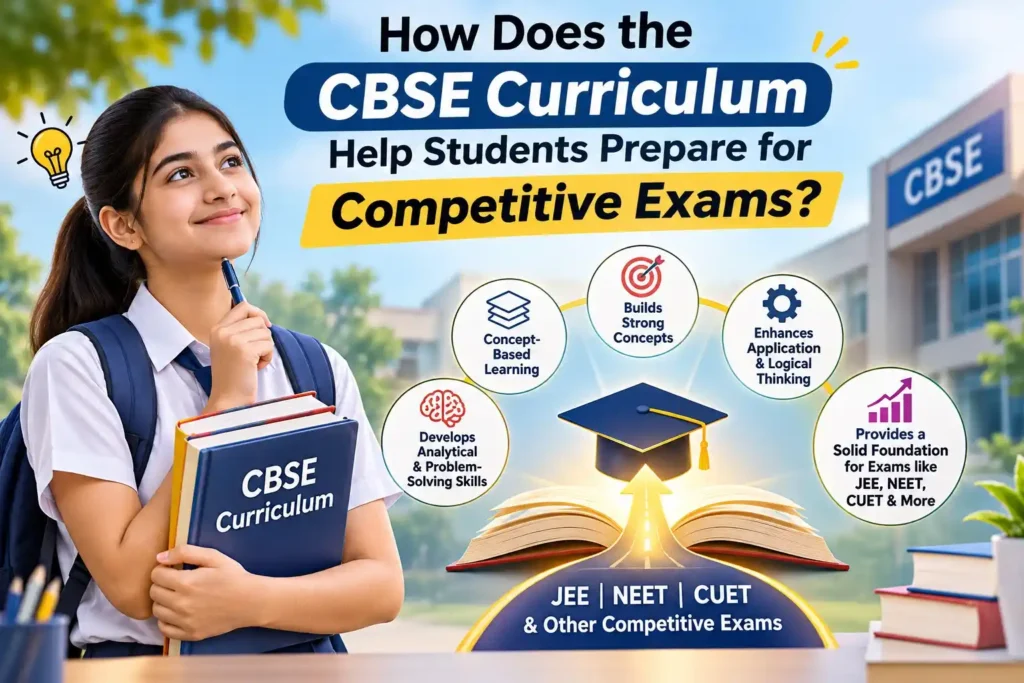
Preparing for competitive examinations requires more than memorising facts or completing textbooks. Students need conceptual clarity, analytical thinking, problem-solving abilities, and consistent practice to perform well in entrance tests. CBSE Schools in Pune help students develop these skills through a structured curriculum that emphasises subject knowledge, practical learning, and regular assessment. When supported by effective teaching and disciplined study habits, the Central Board of Secondary Education (CBSE) framework can provide a strong foundation for examinations such as JEE, NEET, CUET, and other national-level entrance tests.
1. Understanding the CBSE Curriculum and Its Academic Approach
The CBSE curriculum is designed to provide students with a structured education across core subjects, including Mathematics, Science, Social Science, and languages. It combines theoretical knowledge with practical activities, classroom discussions, assignments, and assessments to support a more complete learning experience.
One important feature is its emphasis on understanding concepts rather than relying entirely on rote memorisation. Students are encouraged to understand scientific principles, apply mathematical formulas, interpret information, and explain their reasoning.
These abilities are valuable in competitive examinations, where questions often require students to apply familiar concepts to unfamiliar situations. For example, solving a Physics numerical problem requires an understanding of the underlying principle, not simply memorising a formula.
The curriculum also provides continuity between school classes, helping students gradually build the knowledge required for more advanced subjects in Classes 11 and 12.
For parents, understanding this academic approach is important because a strong school education can make additional entrance exam preparation more manageable.
2. How CBSE Schools in Pune Build Strong Conceptual Foundations
A clear understanding of fundamental concepts is essential for competitive exam success. Students who develop strong basics during their school years are often better equipped to understand advanced topics later.
CBSE Schools in Pune follow a structured syllabus that introduces concepts progressively, allowing students to connect earlier lessons with more complex material. In Mathematics, students develop numerical reasoning and logical thinking. In Science, they learn to analyse relationships, understand processes, and apply theoretical knowledge.
For example, a student who understands algebraic expressions and equations in earlier classes may find higher-level mathematical problems easier to approach. Similarly, a strong understanding of chemical reactions and fundamental Physics principles can support preparation for engineering and medical entrance examinations.
Teachers can strengthen these foundations through classroom explanations, worked examples, laboratory activities, homework, and chapter-wise revision.
Students also benefit when teachers encourage questions and explain why a particular method works instead of simply demonstrating the correct answer.
This approach helps learners develop independent thinking, improve accuracy, and recognise the underlying concepts behind different question formats.
3. The Importance of NCERT Textbooks in Competitive Exams
NCERT textbooks are an important part of the CBSE learning framework and play a significant role in building subject knowledge for several competitive examinations.
For NEET aspirants, NCERT Biology is particularly important because detailed knowledge of prescribed concepts, terminology, diagrams, and processes supports effective preparation. NCERT Chemistry and Physics also provide valuable foundational knowledge.
For JEE aspirants, NCERT textbooks help students understand essential concepts in Physics, Chemistry, and Mathematics. However, JEE preparation, especially for the more advanced questions, generally requires additional problem-solving practice beyond school-level exercises.
Students preparing for CUET may also benefit from understanding the relevant Class 12 subject content and checking the current examination syllabus for their chosen subjects.
Parents should remember that the exact requirements vary by examination and year. Students must consult official examination information rather than assuming that school textbooks alone cover every question type.
A balanced strategy involves understanding NCERT material thoroughly, revising regularly, and gradually progressing to examination-specific practice questions.
4. Developing Analytical Thinking and Problem-Solving Skills
Competitive examinations frequently test a student’s ability to interpret information, recognise patterns, evaluate options, and solve problems within a limited time.
The CBSE curriculum can help develop these abilities through mathematics exercises, scientific investigations, project work, classroom discussions, and application-based questions.
For instance, a Mathematics question may require students to combine multiple concepts instead of applying a single memorised formula. A Science activity may encourage them to observe results, identify relationships, and explain their conclusions.
These experiences build analytical reasoning and help students become more comfortable with challenging academic tasks.
Teachers can further strengthen problem-solving skills by presenting different methods of solving a question, encouraging students to explain their reasoning, and discussing common mistakes.
Students should also practise identifying why an answer is incorrect. Reviewing mistakes improves understanding and reduces the likelihood of repeating the same errors in future tests.
Parents researching the Best CBSE Schools in Pune should therefore consider how schools encourage critical thinking and independent learning, rather than focusing exclusively on examination percentages.
5. Regular Assessments and Examination Readiness
Regular assessment helps students monitor their progress and identify areas that require improvement. School tests, assignments, practical examinations, and periodic assessments provide opportunities to revise material and strengthen understanding.
These activities also encourage students to develop examination habits, including reading questions carefully, organising answers, managing time, and checking their work.
However, competitive examinations often use question formats and time limits that differ from regular school examinations. Students preparing for JEE, NEET, or CUET should therefore supplement school assessments with relevant mock tests and timed practice.
Schools that provide additional objective tests, question banks, doubt-clearing sessions, and performance reviews can help students understand their readiness more clearly.
A useful assessment process should identify specific weaknesses instead of simply reporting marks. For example, a student who loses marks because of calculation errors needs a different strategy from someone who has not understood the concept.
When teachers provide constructive feedback, students can adjust their study plans and focus their efforts more effectively.
6. Supporting Preparation Through Practical and Experiential Learning
Practical learning connects theoretical knowledge with real-world observations. Laboratory experiments, projects, demonstrations, and educational activities can make difficult concepts easier to understand and remember.
In Physics, practical demonstrations help students explore principles such as motion, electricity, and light. Chemistry experiments provide opportunities to observe reactions and understand scientific procedures. Biology activities can help students understand structures, systems, and biological processes.
These experiences develop curiosity and reinforce classroom learning. They can also improve observation, interpretation, and scientific reasoning, which are useful across many academic disciplines.
The effectiveness of practical learning depends on how well activities are connected to the syllabus. Simply completing an experiment is less valuable than understanding its purpose, explaining the observations, and connecting the results with relevant scientific principles.
Parents comparing the Top CBSE Schools in Pune should ask whether students have regular access to laboratories, qualified instructors, and opportunities to participate in meaningful practical activities.
7. Building Time Management, Discipline, and Independent Study Habits
Competitive examinations require sustained preparation over several months. Students must balance schoolwork, revision, practice questions, mock tests, and personal responsibilities.
The structured academic calendar followed by CBSE-affiliated institutions can help students develop consistency and accountability. Regular assignments, deadlines, classroom tests, and revision schedules encourage learners to plan their time and complete tasks systematically.
Students can build more effective study habits by dividing large chapters into smaller sections, setting realistic weekly goals, and revisiting previously studied topics.
A practical preparation routine should include:
- Concept learning: Understand the topic before attempting difficult questions.
- Daily practice: Solve relevant problems consistently rather than studying only before tests.
- Revision: Review earlier chapters to strengthen long-term retention.
- Mock tests: Practise under examination-like conditions and analyse mistakes.
- Balanced routines: Maintain adequate sleep, physical activity, and relaxation.
Schools and parents should avoid creating unnecessarily demanding schedules. Consistent, focused preparation is generally more sustainable than long study hours without proper breaks.
8. Choosing a School That Supports Competitive Exam Goals
Although the CBSE curriculum provides a useful academic foundation, students’ preparation also depends on the quality of teaching, learning resources, and additional academic support available at their school.
Some institutions offer integrated coaching for JEE or NEET, while others focus on regular board education. Neither arrangement automatically guarantees better results. The right choice depends on the student’s learning style, academic needs, and ability to manage the workload.
When evaluating CBSE Schools Pune, parents should look beyond promotional claims and understand how the school supports students throughout the academic year.
Consider these factors:
- Teachers’ qualifications, subject knowledge, and teaching experience.
- Availability of remedial classes and individual doubt-clearing support.
- Access to laboratories, libraries, digital learning resources, and practice materials.
- Frequency of assessments and the quality of feedback.
- Integrated coaching arrangements, if offered, and their additional costs.
- Student counselling, workload management, and overall well-being.
Parents can also review school affiliation details, speak with existing families, and visit the campus to understand the learning environment.
Educational resources and school-related updates from platforms such as Edu India News may support the initial research process, but families should verify important claims directly with schools and official sources.
9. Preparing for Different Competitive Examinations
The CBSE curriculum can support preparation for multiple entrance examinations, but students need to adapt their study methods to each examination’s requirements.
JEE focuses on Physics, Chemistry, and Mathematics, with an emphasis on numerical ability, conceptual application, and problem-solving. NEET tests Physics, Chemistry, and Biology and requires detailed subject knowledge, accuracy, and efficient time management.
CUET provides access to participating universities and programmes through examination components that vary according to the course and current admission requirements.
Students should identify their intended career path early enough to plan their preparation sensibly, without feeling pressured to make an irreversible decision too soon.
A good strategy is to build strong school-level foundations first, then align additional practice with the official syllabus, examination pattern, and eligibility criteria for the chosen test.
This combination allows students to manage board examinations and competitive preparation more effectively while avoiding unnecessary duplication of study efforts.
Conclusion
CBSE Schools in Pune can help students prepare for competitive examinations by developing conceptual understanding, analytical reasoning, practical knowledge, and consistent study habits. The curriculum provides a strong starting point, while mock tests, focused revision, and examination-specific practice help students prepare for the demands of entrance tests.
Parents should evaluate teaching quality, academic support, learning resources, and student well-being when selecting a school. Ultimately, success depends on the combination of a supportive educational environment, effective preparation, and the student’s sustained effort.
Frequently Asked Questions (FAQs)
- Does the CBSE curriculum help with competitive exams?
Yes. It builds subject knowledge, conceptual clarity, and problem-solving skills needed for entrance examinations.
- Are NCERT textbooks enough for JEE and NEET?
NCERT provides essential foundations, but additional practice and examination-specific preparation are usually necessary.
- Which competitive exams can CBSE students prepare for?
Students can prepare for JEE, NEET, CUET, and other entrance examinations, depending on their academic goals.
- When should students begin competitive exam preparation?
Students can strengthen their fundamentals in Classes 9 and 10 before beginning focused preparation in Classes 11 and 12.
- How should parents choose a CBSE school?
Compare teaching quality, academic support, facilities, assessment methods, fees, and student well-being.